
I. Why Visit Temples in Bangkok?
Bangkok is a city of mesmerizing contrasts, where futuristic skyscrapers pierce the sky alongside golden temple spires that have stood for centuries. For visitors, the true soul of Thailand’s capital is not found in its bustling markets or vibrant nightlife alone, but within the serene, sacred spaces of its iconic Bangkok temples. These complexes, known as wats, are far more than places of worship. They are the living heart of Thai culture—centers of community, artistry, history, and spiritual devotion.
A visit to these temples is an essential journey into the nation’s identity. From the dazzling, jewel-encrusted home of the Emerald Buddha to a humble neighborhood monastery, each temple tells a unique story. This guide explores the 12 most sacred and significant Bangkok temples, offering you a curated path through the city’s spiritual landscape. Whether you seek architectural wonder, historical insight, or a moment of profound peace, these sacred sites promise an unforgettable exploration.
II. The Top 12 Bangkok Temples to Explore
Wat Phra Kaew & The Grand Palace
Why it’s a must: This is the most sacred Buddhist temple in all of Thailand. Wat Phra Kaew, commonly called the Temple of the Emerald Buddha, resides within the grounds of the majestic Grand Palace. It serves as the royal chapel and the spiritual core of the Thai kingdom, holding immense national significance.
Key Features: The temple’s centerpiece is the revered Emerald Buddha, carved from a single block of jade. Despite its name, the statue is small (66 cm tall) but sits high atop an elaborate golden altar. The surrounding complex is a masterpiece of Thai architecture: glittering with colored glass and gold leaf, guarded by towering mythical giants (Yakshas), and adorned with intricate murals depicting the Thai epic, the Ramakien. The adjacent Grand Palace, with its blend of Thai and European styles, adds to the overwhelming sense of grandeur.
Practical Info:
- Located in Phra Nakhon district.
- Open daily 8:30 AM – 3:30 PM.
- Entrance fee is 500 THB.

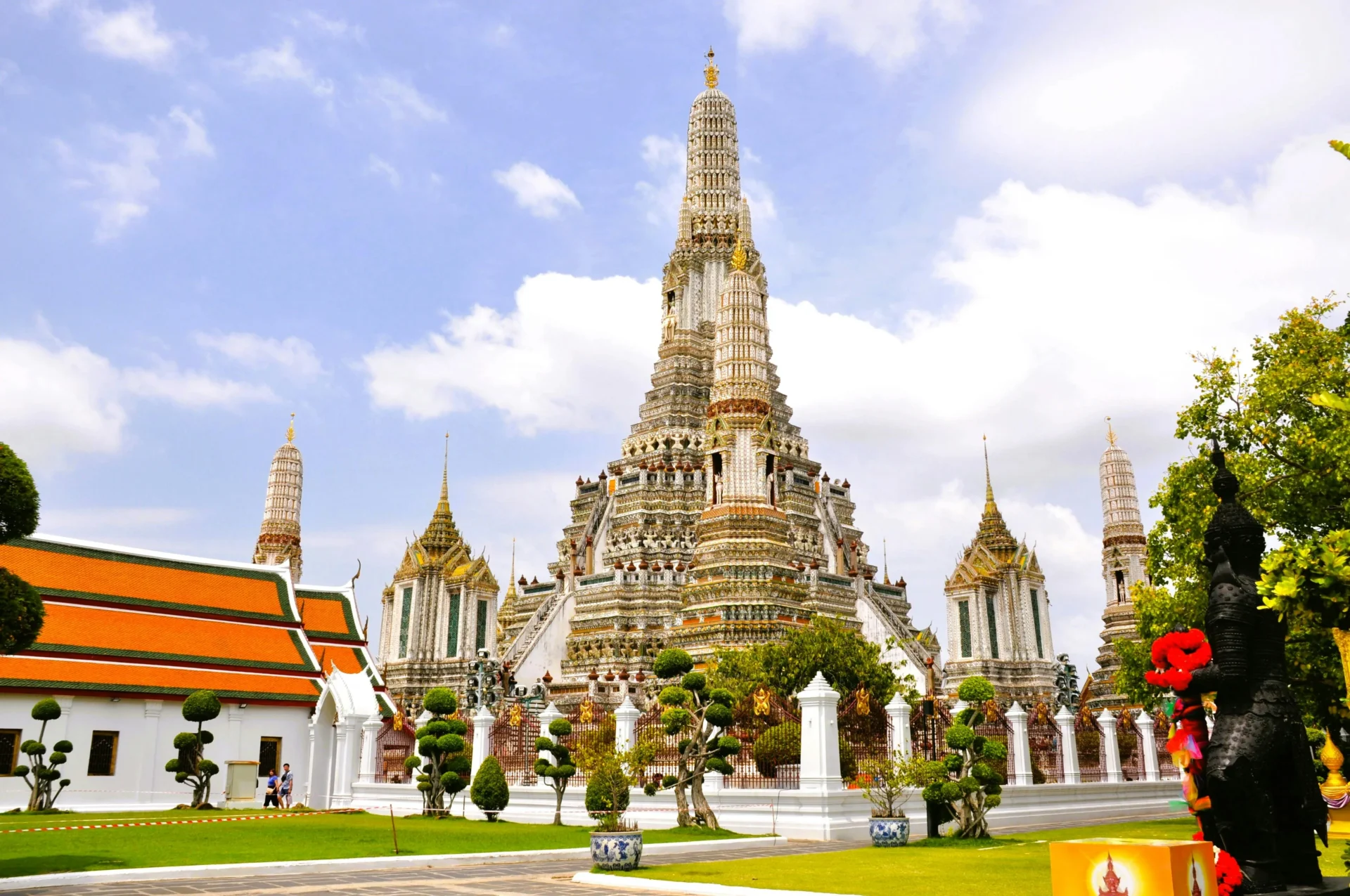
Wat Arun (The Temple of Dawn)
Why it’s a must: With its iconic silhouette gracing the Chao Phraya River, Wat Arun is arguably Bangkok’s most recognizable landmark. It is named after Aruna, the Indian god of dawn, and is stunning when the first light catches its porcelain surface.
Key Features: The central prang (spire) stands over 70 meters tall, symbolically representing Mount Meru, the center of the universe in Buddhist cosmology. What makes it extraordinary is its decoration: millions of pieces of Chinese porcelain and seashells embedded in the stucco, creating a dazzling, mosaic-like effect. Climbing the steep stairs of the central prang offers spectacular views of the river and Wat Pho opposite.
Practical Info:
- Located on the Thonburi side of the Chao Phraya River in Bangkok Yai district.
- Open daily 8:00 AM – 6:00 PM.
- Entrance fee: 100 THB.
Wat Pho (The Temple of the Reclining Buddha)
Why it’s a must: Located just south of the Grand Palace, Wat Pho is famous for housing the enormous Reclining Buddha. It is also considered Thailand’s first public university and remains the national headquarters for the teaching and preservation of traditional Thai medicine and massage.
Key Features: The Reclining Buddha is an astounding 46 meters long and 15 meters high, entirely covered in gold leaf. The statue depicts the Buddha entering Nirvana. The soles of its feet are beautifully inlaid with mother-of-pearl, displaying 108 auspicious laksanas (characteristics) of the Buddha. The temple grounds are vast, containing over 1,000 Buddha images and a forest of 91 chedis (stupas), four of which are particularly large and glazed in green.
Practical Info:
- Located in Phra Nakhon district.
- Open daily from 8:00 AM to 7:30 PM.
- Entrance fee: 200 THB.

Wat Saket (The Golden Mount)
Why it’s a must: This temple offers one of the best panoramic views of old Bangkok. An artificial hill topped with a gleaming golden chedi, Wat Saket provides a rewarding climb and a peaceful escape from the city streets below.
Key Features: The climb involves over 300 steps that spiral around the mount, passing quiet bells, Buddha images, and shaded resting points. The summit reveals a stunning 360-degree view of the Bangkok skyline. The golden chedi itself is said to house a relic of the Buddha. During the Loy Krathong festival in November, the mount is decorated with vibrant red cloth and becomes the site of a major celebration.
Practical Info:
- Located in Pom Prap Sattru Phai district.
- Open daily 7:00 AM – 7:00 PM.
- Entrance fee: 50 THB. Visit early in the morning for cooler temperatures and clearer views, or in the late afternoon for sunset.

Wat Benchamabophit (The Marble Temple)
Why it’s a must: Renowned for its elegant and unique architecture, Wat Benchamabophit is one of Bangkok’s most visually harmonious temples. Built from white Carrara marble imported from Italy, it presents a refined blend of Thai and European neoclassical design.
Key Features: The main ubosot (ordination hall), with its graceful lines and marble courtyard, reflects in a tranquil canal filled with lotus flowers—a favorite photo spot. The interior is lavishly decorated. In the courtyard behind the main hall, a gallery features a collection of 52 Buddha images representing various styles and periods from across Asia, making it a mini-museum of Buddhist iconography.
Practical Info:
- Located near Dusit Palace and Chitralada Palace in the Dusit district.
- Open daily from 6:00 AM to 6:00 PM.
- Entrance fee: 50 THB.

Wat Traimit (Temple of the Golden Buddha)
Why it’s a must: This temple in the heart of Chinatown (Yaowarat) holds an astonishing secret: the world’s largest solid gold Buddha statue. Weighing 5.5 tons, its true value and composition were only discovered by accident in the 1950s.
Key Features: The Golden Buddha is a magnificent sight, seated in a graceful posture. The statue dates back to the Sukhothai period (13th-14th century) and was likely covered in plaster to hide it from invading armies centuries ago. It was only when it was being moved and the plaster cracked that the solid gold underneath was revealed. The statue now resides on the top floor of a modern, multi-story pavilion, which also houses a museum on the history of Chinatown.
Practical Info:
- Located at the entrance to Chinatown on Traimit Road.
- Open daily 8:00 AM – 5:00 PM.
- Entrance fee: 100 THB to see the gold Buddha.

Wat Ratchabophit
Why it’s a must: A lesser-known gem, Wat Ratchabophit is celebrated for its uniquely symmetrical design and fascinating fusion of Thai and European Gothic architectural elements. It offers a quiet and scholarly atmosphere away from the main tourist trails.
Key Features: The temple’s layout is perfectly circular. The main chedi, gilded in gold, stands at the center of a circular courtyard. Surrounding it is a cloister with doors and windows featuring pointed Gothic arches, a highly unusual feature in Thai temple design. The interior of the ubosot is equally stunning, with royal blue walls and exquisite mother-of-pearl inlay work on the doors, depicting royal insignia.
Practical Info:
- Located not far from Wat Pho and the Grand Palace.
- Open daily 6:00 AM – 6:00 PM.
- No entrance fee.

Wat Ratchanatda (and Loha Prasat)
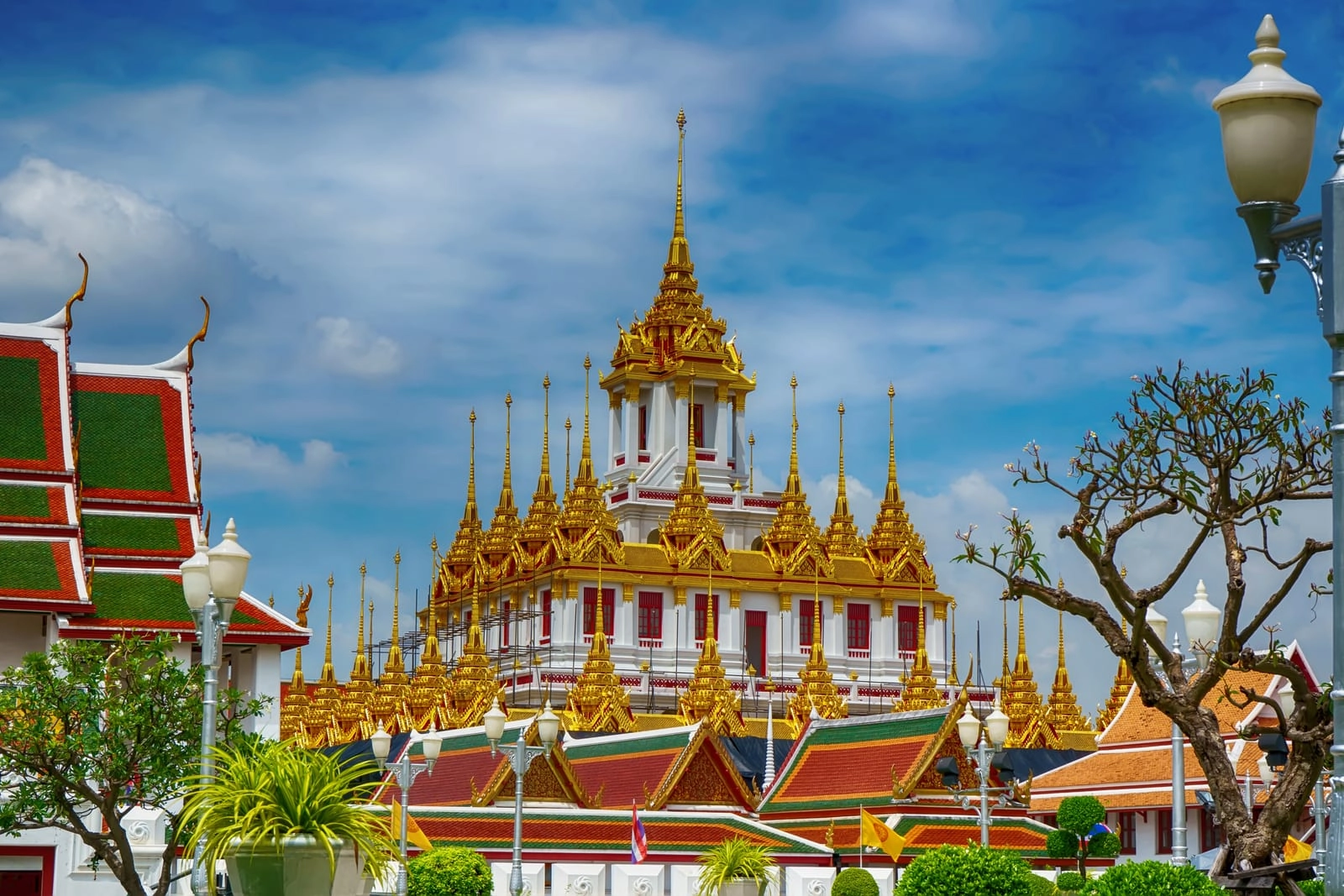
Why it’s a must: This temple complex is home to the unique Loha Prasat, or “Metal Castle,” one of only three such structures remaining in the world. Its striking, multi-tiered design stands out amidst Bangkok’s more traditional spires.
Key Features: The Loha Prasat is a 36-meter-tall structure with 37 metal spires, representing the 37 virtues toward enlightenment. Visitors can climb the central staircase to the top for a view over the complex. Next door is the bustling Amulet Market, where collectors and devotees buy tiny Buddhist charms. Wat Ratchanatda itself features a beautiful, large viharn (assembly hall) with a distinctive green-roofed tiered structure.
Practical Info:
- Located near the Democracy Monument and Mahakan Fort.
- Open daily 8:00 AM – 5:00 PM.
- Entrance fee: 20 THB is required to climb the Loha Prasat.
Wat Bowonniwet Vihara
Why it’s a must: This is a temple of great royal and religious significance. It is the headquarters of the Thammayut monastic order and has close ties to the Thai royal family, serving as the temple where King Rama IV (King Mongkut) and the current King Rama X served as abbots.
Key Features: While not as visually flamboyant as others, Wat Bowon boasts exquisite mural paintings inside its main chapel, including some influenced by Western artistic techniques introduced during King Rama IV’s reign. It is a major center for Buddhist studies and meditation, attracting monks and serious practitioners. The atmosphere is one of serene scholarship rather than tourist spectacle.
Practical Info:
- Located in the Phra Nakhon district, near Khao San Road.
- Open daily 6:30 AM – 4:00 PM.
- No entrance fee.

Wat Suthat & The Giant Swing
Why it’s a must: One of Bangkok’s oldest and most important temples, Wat Suthat is known for its massive scale, exquisite murals, and the iconic Giant Swing (Sao Ching Cha) standing in its plaza.
Key Features: The main prayer hall is one of the largest in Bangkok, housing an impressive 8-meter-tall bronze Buddha image from the Sukhothai period. The walls are covered with detailed, well-preserved murals from the early Rattanakosin era. Outside, the towering red pillars of the Giant Swing, once used in an ancient Brahmin ceremony, make for a dramatic sight. The temple’s intricate wooden sala (pavilion) is considered a masterpiece of Thai carpentry.
Practical Info:
- Located in the Phra Nakhon district.
- Open daily from 8:30 AM to 8:00 PM.
- Entrance fee: 20 THB.

Wat Prayoon
Why it’s a must: A charming and whimsical temple often overlooked by tourists, Wat Prayoon feels like a secret garden. It is famous for its unique “Turtle Mountain” and tranquil, romantic atmosphere.
Key Features: The centerpiece is a large, white chedi rising from an artificial hill surrounded by a moat. The hill is covered with rockeries and hundreds of turtles (both statues and live ones in the pond), symbolizing longevity. Bridges, caves, and hidden shrines make exploration delightful. The mix of Thai, Chinese, and European architectural influences reflects the cosmopolitan history of the Thonburi side.
Practical Info:
- Located on the Thonburi side of the river, near Memorial Bridge.
- Open daily from 7:00 AM to 8:00 PM.
- No official entrance fee.

Wat Paknam Bhasicharoen
Why it’s a must: This temple represents the modern evolution of Thai Buddhist architecture. Its recently completed Phra Maha Chedi, a colossal five-sided pagoda, has become a new landmark on the Bangkok skyline.
Key Features: The towering white and gold chedi is an engineering marvel. Inside, it is even more breathtaking, with every surface covered in intricate, colorful mosaic art depicting Buddhist cosmology across five stunning floors. A high-speed elevator takes visitors to an observation deck at the top for unparalleled 360-degree views of Bangkok. The temple is a major meditation center following the teachings of the famous monk Luang Pu Sodh.
Practical Info:
- Located in the Phasi Charoen district, a bit further from the city center.
- Open daily from 6:00 AM to 8:00 PM.
- No official entrance fee.

III. Essential Tips Before You Go
To ensure a respectful and enjoyable visit to these sacred sites, keep these essential guidelines in mind:
- Respect the Dress Code: This is non-negotiable. Clothing must cover your shoulders and knees. Avoid tight, transparent, or revealing clothing. Both men and women should adhere to this. Most major temples have sarongs for rent if needed, but it’s best to come prepared.
- Act with Deference: Temples are active places of worship. Speak quietly, avoid loud laughter, and never point your feet at Buddha images (sitting with feet tucked behind you is best). When sitting in a chapel, try to keep your feet pointed away from the main altar.
- Footwear Etiquette: Always remove your shoes before entering any building where a Buddha image is housed (the ubosot or viharn). Leave them on the provided racks.
- Photography Rules: Be discreet. Avoid using flash inside dark chapels, as it can damage ancient art. Look for signs prohibiting photography in certain areas, especially of the main Buddha images in some temples. Never climb on statues or structures for a photo.
- Interacting with Monks: Women must never touch a monk or directly hand him something. If you wish to make an offering, place it on a cloth in front of him or on a table. Monks are often happy to have a respectful conversation, but always let them initiate if they are open to it.
- Plan Your Timing: The best time to visit any temple is early in the morning (around 8:00 AM). It’s cooler, the light is beautiful for photography, and you’ll avoid the large tour groups that arrive from 10:00 AM onward.
Exploring the magnificent Bangkok temples is a journey through art, faith, and history. To delve even deeper with expert guidance and seamless logistics, consider a curated tour.
Let the experts at Aravinda Travel craft your perfect temple-hopping itinerary, ensuring you experience the profound beauty and spiritual depth of Bangkok’s sacred sites in comfort and style. Contact Aravinda Travel today to begin your journey.
Contact Details:
- Website: aravindatravel.com
- Facebook: Aravinda Travel – Loyal DMC in South East Asia
- Email: info@aravindatravel.com
- 24/7 Hotline: +84 989 383 572