

I. Overview of Hue Airport Vietnam (Phu Bai International Airport – HUI)
Arriving at Hue Airport is more than the end of a journey — it is a quiet transition into Vietnam’s imperial past. As you descend, the lush landscape of Central Vietnam unfolds, with the Perfume River winding through a city shaped by centuries of royal heritage. Once the imperial capital, Hue retains a timeless atmosphere, where ancient temples, historic citadels, and a slower, more reflective pace define the experience.
Phu Bai International Airport (HUI), located about 15 km south of the city center, offers a calm and efficient entry point that mirrors the character of Hue itself. Unlike major transit hubs, it serves as a peaceful gateway into one of the country’s richest cultural regions. As part of the wider network of Vietnam international airports, Hue Airport connects travelers directly to iconic landmarks such as the Imperial City, royal tombs, and centuries-old pagodas — making it the ideal starting point for a journey into Vietnam’s cultural heart.

II. Transportation from Hue Airport to the City
Private Transfers (Recommended)
A private transfer is the most comfortable way to travel from Phu Bai Airport to Hue city center, taking around 20–25 minutes. With a professional driver and direct service to your hotel, it ensures a smooth and stress-free arrival — an ideal start for a well-planned journey. For added convenience, you can arrange this service through travel agencies such as Araninda Travel, which often provide well-organized, reliable transfers tailored to your itinerary.
Taxi Options
Metered taxis are readily available outside the arrivals exit, with reputable companies offering fixed-rate or metered fares into the city center. The journey is straightforward, the distance is short, and pricing is modest by any international standard. For independent travelers comfortable with arranging transport on arrival, this is a perfectly viable option.
Hotel Transfers
Many of Hue’s boutique hotels and luxury properties offer airport pickup services for guests, either complimentary or at a fixed rate. Given the relatively short distance and the generally high standard of hospitality at Hue’s better hotels, this is worth enquiring about at the time of booking. It is a small but meaningful detail that contributes to the quality of an arrival.
III. Terminals at Hue Airport
Domestic flights from Phu Bai – Hue airport (HUI) to other provinces/cities include:
Domestic flights
- Hue (HUI) – City. Ho Chi Minh (SGN)
- Hue (HUI) – Hanoi (HAN)
- Hue (HUI) – Hai Phong (HPH)
- Hue (HUI) – Phu Quoc (PQC)
- Hue (HUI) – Da Lat (DLI)
Domestic flights from other provinces/cities to Phu Bai – Hue Airport (HUI) are as follows:
- City. Ho Chi Minh (SGN) – Hue (HUI)
- Hanoi (HAN) – Hue (HUI)
- Phu Quoc (PQC) – Hue (HUI)
International flights
Besides domestic flights, Phu Bai Airport also has international flights. However, the frequency of flights from this airport to other countries is still quite sparse.

IV. Best Destinations from Hue Airport
Hue Imperial City
The Hue Citadel and its Imperial City constitute one of the most significant historical complexes in Southeast Asia — a UNESCO World Heritage Site that encompasses royal palaces, ceremonial halls, pavilions, and gardens spread across a walled precinct beside the Perfume River. It is a place that rewards time and attention, and no visit to Hue is complete without at least a full day within its walls.

Perfume River and Thien Mu Pagoda
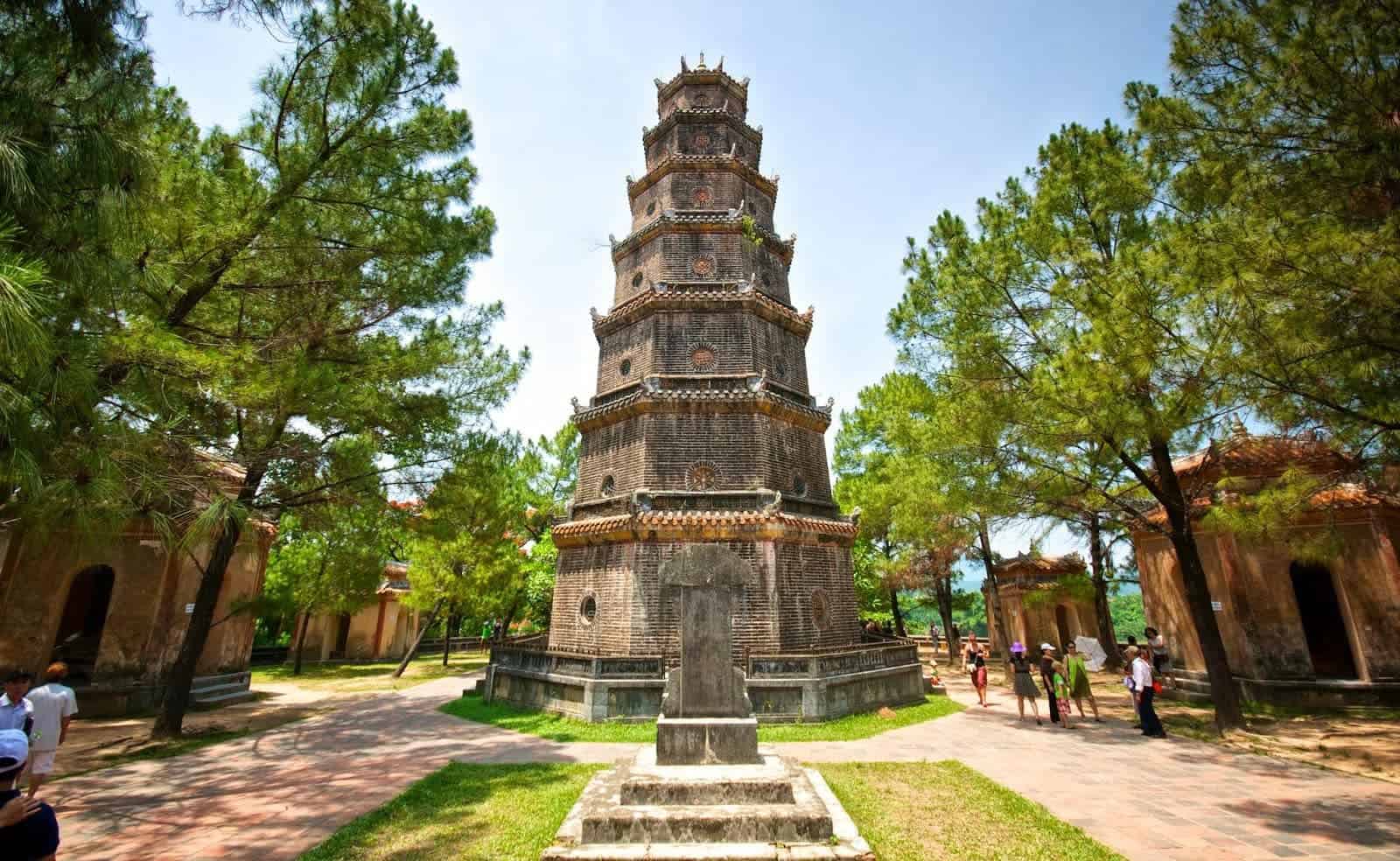
The Perfume River — so named for the flower petals that once drifted downstream from the orchards upstream — is the landscape element that gives Hue much of its beauty and spiritual character. A boat journey along its length, pausing at Thien Mu Pagoda with its iconic seven-story tower, is among the most quietly memorable experiences in Central Vietnam. The pagoda itself is one of the oldest and most revered in the country, and the view from its grounds across the river is one that stays with you.
Royal Tombs
Scattered through the forested hills south of Hue, the royal tombs of the Nguyen emperors are monuments of remarkable individuality and artistry. Minh Mang’s tomb is formal and Confucian in its geometry. Khai Dinh’s is eccentric and European-influenced, its interior covered in mosaic glass and ceramic. Tu Duc’s is contemplative and surrounded by a landscape of pines and lotus ponds. Each reflects the personality of the emperor it honors — and together they constitute an open-air museum of royal character unlike anything else in Vietnam.
These are not simply tourist attractions. They are the physical memory of a civilization — and exploring them with the depth they deserve is what travel to Hue is ultimately about.

V. Hue vs Other Airports in Vietnam
Hue vs Da Nang Airport
The comparison between Hue and Da Nang airports is, in many ways, a comparison between two different travel philosophies. Da Nang is modern, busy, and oriented toward a diverse mix of beach tourism, cultural day trips, and transit traffic. It handles far greater passenger volumes and offers a wider range of facilities and international connections. Hue, by contrast, is smaller, quieter, and focused with remarkable clarity on a single type of traveler — one who comes for the culture, the history, and the particular unhurried beauty of a city that has never entirely left its imperial past behind. Neither is superior. They simply serve different journeys.
Hue vs Hanoi and Ho Chi Minh City
Against the major hubs of Hanoi and Ho Chi Minh City, Hue Airport operates in an entirely different register. Where Noi Bai and Tan Son Nhat are complex, high-volume international gateways serving cities of millions, Phu Bai is an intimate and calm point of entry into a city of a very different scale and character. The experience of arriving at Hue Airport — the ease of it, the quiet, the sense of having stepped into somewhere genuinely distinct — is something the major hubs, for all their sophistication, cannot offer. Hue is, in the best possible sense, a softer and more poetic entry into Vietnam.
make Hue’s particular kind of depth more accessible — while keeping that depth intact.
VI. Conclusion
Hue Airport is not the grandest airport in Vietnam. It does not need to be. What it offers is something rarer and, for the right traveler, considerably more valuable — an arrival that is already an experience, a gateway that is already infused with the spirit of the destination it serves.
Beyond the terminal, a city of extraordinary historical depth awaits. The citadel. The river. The tombs. The temples. The cuisine that emperors once ate and that street vendors still serve in the same form today. Vietnam reveals itself in many ways and at many speeds — but in Hue, it reveals itself slowly, beautifully, and with a depth that rewards those who take the time to truly look.
The journey into Vietnam’s imperial heart begins gently, at gate HUI. And what follows, for those who arrive with curiosity and openness, is among the most meaningful travel experiences the country has to offer. Plan ahead, book your transportation in advance, and Aravinda Travel do the rest.
Your journey will be smoother with the support of Aravinda Travel. We will design a perfect itinerary, personalize your trip, and provide you with the most exceptional experiences.
Contact Aravinda Travel to begin your journey:
- Website: aravindatravel.com
- Facebook: Aravinda Travel – Loyal DMC in South East Asia
- Email: info@aravindatravel.com
- 24/7 Hotline: +84 989 383 572