

The 36 streets Hanoi district originated in the Ly and Tran dynasties, becoming a bustling trade center from as early as the 11th century. Each street was historically named after a specific craft, resulting in unique names that instantly bring the image of the old quarter to mind.
This area is a magnet for both domestic and international tourists. Aravinda Travel provides insights into experiencing Hanoi’s rich culture within these 36 streets.
An Introduction to the 36 Streets of Hanoi
Overview
Historical accounts note that King Le Hien Tong organized the Thang Long citadel into 36 zones, known as the 36 streets, in 174. These areas were part of Vinh Xuong and Quang Duc districts and formed a vibrant commercial town shaped by local trades.
The 36 streets of Hanoi are the ancient urban quarters situated within and around the Hanoi Old Quarter. This area is distinguished by its craft streets and old houses that showcase traditional Vietnamese architectural styles.
Historically, artisans from surrounding villages would congregate here to trade, organizing themselves into zones dedicated to their village’s primary goods. The streets were consequently named after these products, prefixed with the word “Hang.”

36 Streets of Hanoi Map
The Old Quarter is primarily located to the North and West of Hoan Kiem District. Visitors can easily access it on foot from Hoan Kiem Lake, or use other landmarks like Dong Xuan Market or O Quan Chuong as starting points.
As defined by the Ministry of Construction, the Old Quarter’s boundaries are: Hang Dau Street to the north; Phung Hung Street to the west; streets including Hang Bong, Hang Gai, Cau Go, and Hang Thung to the south; and Tran Quang Khai and Tran Nhat Duat streets to the east.
The Hanoi Old Quarter is located in Hoan Kiem district, covering approximately 100 hectares and comprising 76 streets across 10 wards: Hang Dao, Hang Bac, Hang Buom, Hang Bo, Hang Bong, Hang Gai, Hang Ma, Dong Xuan, Cua Dong, and Ly Thai To.
While other districts like Ba Dinh and Hai Ba Trung also have old streets, the core and best-preserved historic area, retaining its original character, is concentrated here.
Defining Characteristics of the 36 Streets of Hanoi
Architecture
The architecture is a key feature, defined by the “tube house” design, slanted tiled roofs, and shop-front facades. These structures, mainly from the 18th and 19th centuries, may appear small but are cleverly and efficiently arranged to meet all the needs of their residents.
Culture
Visiting the old quarter is like stepping back into a thousand-year-old civilization. Cultural values are preserved in around 100 ancient architectural works, most notably communal houses, temples, pagodas, and assembly halls. A prime example is Bach Ma temple on Hang Buom Street, one of the four sacred temples of ancient Thang Long.
Cuisine
The Old Quarter’s charm is amplified by its small, ubiquitous eateries. While not luxurious, their authentic flavors are a powerful draw for travelers. The local cuisine features classic dishes like Bun Cha, Pho, and vermicelli with fish, served from humble roadside stalls or in aging, multi-decade-old houses.
The Most Prominent Streets in Hanoi’s 36 Streets
Hang Bac Street
Hang Bac Street is among the most ancient and renowned of the 36 streets Hanoi. It specializes in the jewelry trade, offering a wide array of styles that captivate enthusiasts.
In the past, Hang Bac Street was home to three distinct trades: silver casting, goldsmithing, and currency exchange. These crafts were brought by artisans from famous villages: Chau Khe (Hung Yen), Dong Xam (Thai Binh), and Dinh Cong.
Today, while other areas also trade in these goods, Hang Bac Street remains the central hub for jewelry crafting and gold/silver exchange, maintaining its leading reputation for quality.

Hang Tre Street
Hang Tre Street is located in Ly Thai To ward, Hoan Kiem district. Its name, meaning “Bamboo Street,” comes from its history; situated by the Red River, it was a convenient spot for “stalls” selling bamboo.
The street is now a thriving food and beverage destination, with many well-known restaurants and eateries offering diverse menus. It also features impressive French colonial architectural buildings that house various companies and government agencies.
Hang Tre Street was once the site of Hanoi’s first courthouse, which now serves as the headquarters for the Vietnam Mekong River Commission and other agencies.

Cau Go Street
This 250-meter-long street in Hang Bac ward is a one-way thoroughfare in the heart of the old quarter. The street is named Cau Go (“Wooden Bridge”) for a bridge that once crossed a creek connecting two lakes.
Cau Go Street is a food lover’s paradise, offering a range of must-try dishes from sticky rice and seafood to specialized noodle soups.
Hang Dao Street
Hang Dao Street is a historically and commercially significant artery in the heart of the 36 streets Hanoi, running in a north-south direction for nearly 300 meters. It serves as a vital link between the bustling Dong Kinh Nghia Thuc Square near Hoan Kiem Lake and the vibrant Hang Ngang Street.
The street’s legacy is deeply woven into the silk trade, a fact immortalized by its French colonial-era name, “Rue de la Soie” (Silk Road). Throughout its history, Hang Dao Street has been the premier destination for high-quality silk, with shops offering the fabric in a stunning spectrum of colors, from vibrant reds (“dao” can refer to a pinkish-red) to deep indigos.
Beyond its commercial role, the street has long been associated with a certain sophistication; the people of Hang Dao were traditionally known for their elegance and refined taste, embodying a classic and timeless Hanoian style amidst the city’s dynamic energy.
Dong Xuan Street / Market Street
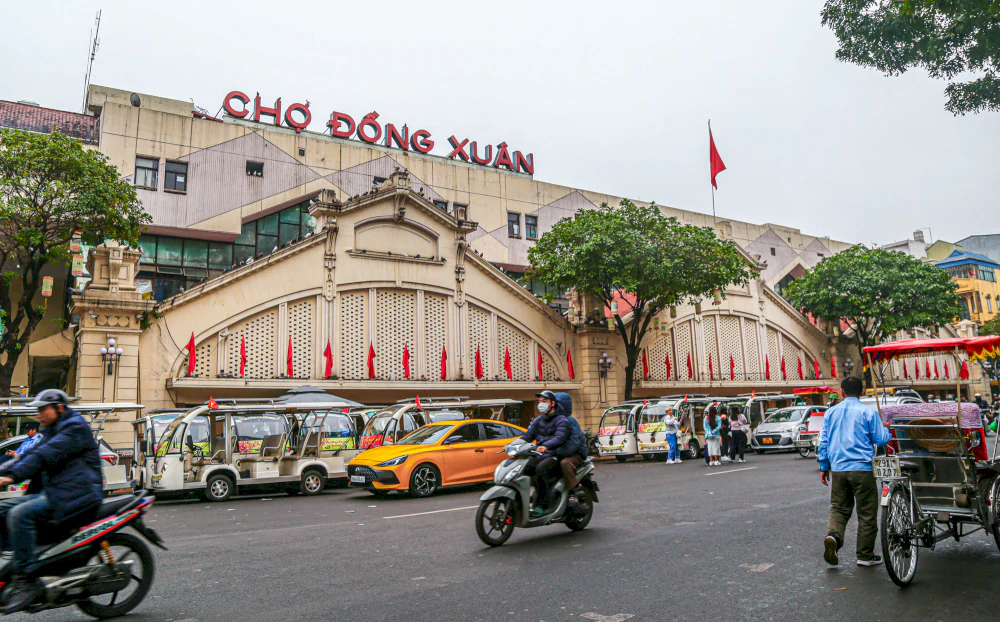
Dong Xuan street, stretching approximately 170 meters through Dong Xuan ward, is arguably the commercial heartbeat of the 36 streets Hanoi. This street is wholly dominated by the presence of the colossal Dong Xuan Market, a multi-story complex that stands as one of the largest and most frenetically active wholesale and retail markets in Northern Vietnam.
More than just a place of commerce, Dong Xuan Market is an indelible cultural symbol, representing the enduring mercantile spirit of Hanoi across centuries. For any visitor, a trip to the 36 streets Hanoi is incomplete without immersing themselves in the market’s vibrant, crowded atmosphere.
The surrounding street and the market’s perimeter are also a haven for street food enthusiasts, offering a chance to enjoy classic local dishes that carry the bold and authentic flavors cherished by Hanoians for generations, providing a true taste of the city’s culinary soul.
Hang Mam Street
Hang Mam is a relatively short but historically flavorful street in the Ly Thai To ward, with a distinct identity within the 36 streets Hanoi. The street’s name, meaning “Fermented Fish Sauce Street”, as it was once the central hub for selling a wide array of fermented seafood products, particularly the pungent and essential Vietnamese fish sauces (mam).
While the air here is no longer thick with the distinct aroma of fermenting fish, the street’s character has evolved. Today, Hang Mam Street has transitioned to specializing in a different set of goods, primarily tombstones, ceramic pottery, and a variety of earthenware and groceries.
Ma May Street
As a famously well-preserved street within the 36 streets Hanoi, Ma May Street is a premier destination, especially for international tourists. Its unique name is a combination of two former street names: “Hang Ma” (Votive Paper Street) and “Hang May” (Rattan Street), reflecting its original trades.
The southern section specialized in selling paper votive items for worship, while the northern part focused on crafting rattan goods.
While a few shops keep these traditions alive, the street now primarily caters to tourism with a vibrant mix of cafes, tailor shops, and restaurants. Be sure to try local dishes like grilled beef stew and chicken noodle soup for a perfect taste of the area’s modern charm.

In this article, Aravinda Travel has shared valuable information for those wishing to discover Hanoi’s culture in the 36 Old Quarter streets. “Hanoi 36 Streets” is a captivating destination for anyone interested in the ancient culture of its people.
To fully immerse yourself in the living history and vibrant culture of the 36 streets Hanoi, contact Aravinda Travel to book a personalized guided tour and discover the hidden stories behind every corner.
Contact Details:
- Website: aravindatravel.com
- Facebook: Aravinda Travel – Loyal DMC in South East Asia
- Email: info@aravindatravel.com
- 24/7 Hotline: +84989383572